

What Is The Best Way To Clean Yellow Stains In The Bathroom From Iron In The Water

Illustration of a bathroom from the early on 20th century, in which announced a bathtub, two towels, a toilet, a sink and two mirrors
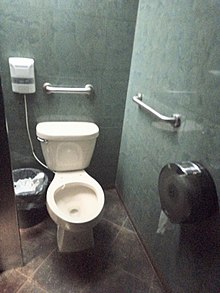
A typical bathroom in a restaurant.
A bathroom or washroom is a room, typically in a habitation or other residential building, that contains either a bathtub or a shower (or both). The inclusion of a launder basin is common. In some parts of the globe e.g. India, a toilet is typically included in the bathroom; in others, the toilet is typically given a dedicated room divide from the one allocated for personal hygiene activities. In N American English the word 'bathroom' is sometimes used to refer to any room in a residence that contains a toilet, regardless of the inclusion of a bath or shower.
Historically, bathing was often a collective activity, which took identify in public baths. In some countries the shared social aspect of cleansing the body is still important, as for example with sento in Japan and the "Turkish bath" (also known by other names) throughout the Islamic world.
Variations and terminology [edit]

The term for the identify used to make clean the body varies around the English-speaking world, every bit does the design of the room itself. A total bathroom is generally understood to incorporate a bath or shower (or both), a toilet, and a sink. An en suite bathroom or en suite shower room is attached to, and only accessible from, a sleeping accommodation. A family bathroom, in British estate agent terminology, is a total bathroom not attached to a bedroom, but with its door opening onto a corridor. A Jack and Jill bath (or continued bathroom) is situated between and usually shared by the occupants of two separate bedrooms. Information technology may also have ii launder basins.[1] [2] A wetroom is a waterproof room usually equipped with a shower; it is designed to eliminate moisture impairment and is compatible with underfloor heating systems.
In the United States, there is a lack of a unmarried definition. This commonly results in discrepancies between advertised and bodily number of baths in real estate listings. Bathrooms are more often than not categorized equally "master bath", containing a shower and a bathtub that is adjoining to the largest bedroom; a "total bathroom" (or "full bath"), containing four plumbing fixtures: a toilet and sink, and either a bathtub with a shower, or a bathtub and a separate shower stall; "half bath" (or "pulverisation room") containing just a toilet and sink; and "3/4 bath" containing toilet, sink, and shower, although the terms vary from marketplace to market place. In some U.S. markets, a toilet, sink, and shower are considered a "full bath." In add-on, in that location is the use of the word "bathroom" to depict a room containing a toilet and a bowl, and nothing else.
In Canada, "washroom" is a frequently used term to refer to such a room, though "bathroom" is also sometimes used.
Pattern considerations [edit]
Towels [edit]
Bathrooms often accept one or more than towel confined or towel rings for hanging towels.
Furniture [edit]
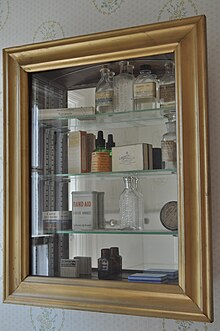
Some bathrooms incorporate a bathroom cabinet for personal hygiene products and medicines, and drawers or shelves (sometimes in column course) for storing towels and other items. Washing Car
Bidet [edit]

A mod bidet of the traditional type
Some bathrooms contain a bidet, which might exist placed side by side to a toilet.
Plumbing [edit]
The design of a bath must account for the use of both hot and cold water, in significant quantities, for cleaning the body. The water is likewise used for moving solid and liquid human waste matter to a sewer or septic tank. Water may exist splashed on the walls and floor, and hot humid air may cause condensation on common cold surfaces. From a decorating point of view the bathroom presents a challenge. Ceiling, wall and floor materials and coverings should be impervious to h2o and readily and easily cleaned. The use of ceramic or drinking glass, as well as smooth plastic materials, is mutual in bathrooms for their ease of cleaning. Such surfaces are ofttimes cold to the bear on, even so, and and then water-resistant bath mats or even bathroom carpets may exist used on the floor to brand the room more than comfortable. Alternatively, the floor may be heated, maybe by strategically placing resistive electric mats nether floor tile or radiant hot water tubing close to the underside of the floor surface.
Electricity [edit]
Electrical appliances, such as lights, heaters, and heated towel rails, generally demand to be installed every bit fixtures, with permanent connections rather than plugs and sockets. This minimizes the run a risk of electric shock. Footing-fault circuit interrupter electrical sockets tin reduce the risk of electric daze, and are required for bathroom socket installation past electrical and edifice codes in the United States and Canada. In some countries, such equally the United Kingdom, merely special sockets suitable for electric shavers and electric toothbrushes are permitted in bathrooms, and are labelled as such.
UK edifice regulations besides define what type of electrical fixtures, such as light fittings (i.eastward. how water-/splash-proof) may exist installed in the areas (zones) around and above baths, and showers.
Lighting [edit]
Bathroom lighting should exist uniform, brilliant and must minimize glare. For all the activities like shaving, showering, training etc. one must ensure equitable lighting across the entire bathroom space. The mirror area should definitely accept at least two sources of light at least 1 feet apart to eliminate whatever shadows on the face. Pare tones and pilus color are highlighted with a tinge of yellow lite. Ceiling and wall lights must be safe for use in a bathroom (electric parts need to be splash proof) and therefore must acquit appropriate certification such equally IP44.
All forms of bathroom lighting should be IP44 rated as safe to use in the bathroom.[iii]
History [edit]

The outset records for the use of baths appointment back as far as 3000 B.C. At this time water had a stiff religious value, beingness seen as a purifying element for both body and soul, and and so it was not uncommon for people to be required to cleanse themselves before entering a sacred area. Baths are recorded as part of a village or boondocks life throughout this period, with a divide between steam baths in Europe and America and cold baths in Asia. Communal baths were erected in a distinctly divide surface area to the living quarters of the village.[ citation needed ]
Near all of the hundreds of houses excavated had their ain bathing rooms. Generally located on the footing floor, the bath was fabricated of brick, sometimes with a surrounding curb to sit on. The water drained away through a hole in the flooring, downward chutes or pottery pipes in the walls, into the municipal drainage system. Even the fastidious Egyptians rarely had special bathrooms.[4]
Greek and Roman bathing [edit]
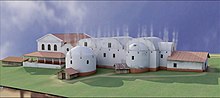
Virtual reconstruction of the Roman Baths in Weißenburg, Germany, using information from laser scan technology
The Roman attitudes towards bathing are well documented; they built big thermal baths (thermae), marking not but an of import social evolution, only besides providing a public source of relaxation and rejuvenation. Here was a identify where people could encounter to hash out the matters of the twenty-four hours and savor entertainment. During this menstruation in that location was a distinction betwixt private and public baths, with many wealthy families having their own thermal baths in their houses. Despite this they still made utilize of the public baths, showing the value that they had every bit a public institution. The strength of the Roman Empire was telling in this respect; imports from throughout the earth allowed the Roman citizens to relish ointments, incense, combs, and mirrors. The partially reconstructed ruins can even so exist seen today, for example at Thermae Bath Spa in Bathroom, England, then part of Roman United kingdom of great britain and northern ireland.
Not all ancient baths were in the style of the large pools that often come to listen when one imagines the Roman baths; the earliest surviving bathtub dates dorsum to 1700 B.C, and hails from the Palace of Knossos in Crete. What is remarkable about this tub is non just the similarity with the baths of today, just also the way in which the plumbing works surrounding it differ so little from modern models. A more advanced prehistoric (15th century BC and before) system of baths and plumbing is to be found in the excavated town of Akrotiri, on the Aegean isle of Santorini (Thera). There, alabaster tubs and other bath fittings were found, forth with a sophisticated twin plumbing system to transport hot and cold water separately. This was probably considering of easy access to geothermic hot springs on this volcanic island.
Both the Greeks and the Romans recognized the value of bathing as an important part of their lifestyles. Writers such as Homer had their heroes bathe in warm water so every bit to regain their strength; information technology is perhaps notable that the mother of Achilles bathed him in order to proceeds his invincibility. Palaces take been uncovered throughout Greece with areas that are dedicated to bathing, spaces with ceramic bathtubs, as well as sophisticated drainage systems. Homer uses the word λοετρά, loetrá, "baths", later on λουτρά, loutrá, from the verb λούειν, loúein, to bathe. The same root finds an fifty-fifty earlier attestation on Linear B tablets, in the proper noun of the River Lousios ("bathing" [river]), in Arcadia. Public baths are mentioned by the comedian Aristophanes as βαλανεία, balaneía (sing.: βαλανείον, balaneíon, Latinized as balneum, a "balneary").
More than recently [edit]
Throughout the 16th, 17th, and 18th centuries, the use of public baths declined gradually in the west, and private spaces were favoured, thus laying the foundations for the bathroom, equally it was to become, in the 20th century. However, increased urbanization led to the creation of more baths and wash houses in Britain.
In Nippon shared bathing in sento and onsen (spas) withal exists, the latter being very popular.
Cultural historian Barbara Penner has written of the ambiguous nature of bathrooms as both the most private space and i most connected to the wider outside world.[5]
Gallery [edit]
-
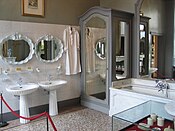
Bathroom in Belgium
-

Illustration of a bathroom from 1903
Encounter likewise [edit]
- Attainable toilet
- Folding screen
- Furo - Japanese bathroom
- Washstand
References [edit]
- ^ Hirsch, William J. (2008). Designing Your Perfect House. Dalsimer Printing. pp. 94–95. ISBN9780979882036.
- ^ "The Benefits of a Jack and Jill Bathroom - Bob Vila". Bob Vila . Retrieved 2016-11-29 .
- ^ "Lighting research center - Bathroom lighting". Article from lighting research center at Rensselaer Polytechnic Institute (Troy, NY 12180 United states). Rensselaer Polytechnic Institute. Archived from the original on 2022-09-07. Retrieved 2011-07-10 .
- ^ Teresi, Dick; et al. (2002). Lost Discoveries: The Ancient Roots of Modern Science—from the Babylonians to the Maya . New York: Simon & Schuster. pp. 351–352. ISBN0-684-83718-viii.
- ^ Penner, Barbara, 1970- (2013). Bathroom. London. ISBN9781780231938. OCLC 834404623.
{{cite book}}: CS1 maint: multiple names: authors list (link)
Further reading [edit]
- von Fürstenberg, Diane (1993). The Bath. Random House. ISBN9780679426790.
- Hoagland, Alison M. (2018). The Bath: A Social History of Cleanliness and the Trunk. ABC-Clio. ISBN9781440852664.
External links [edit]
-
 Media related to Bathroom at Wikimedia Commons

Source: https://en.wikipedia.org/wiki/Bathroom
Posted by: burnettspas1983.blogspot.com
0 Response to "What Is The Best Way To Clean Yellow Stains In The Bathroom From Iron In The Water"
Post a Comment